8 Workplace Injury Myths vs. Statistics in Orlando: What the Numbers Actually Show
Orlando’s economy is often associated with theme parks, hotels, restaurants, retail stores, and office jobs. That image can make workplace injuries seem less common or less serious than accidents in cities dominated by factories, mines, or heavy industry.
The numbers tell a different story.
The Orlando-Kissimmee-Sanford metropolitan area includes Orange, Osceola, Seminole, and Lake counties. Its workforce includes large numbers of food service employees, retail workers, cleaners, maintenance employees, health care professionals, drivers, construction workers, and administrative staff. Each group faces different workplace hazards.
Current injury data is more complete at the Florida level than at the Orlando city level. For that reason, an accurate discussion of workplace injury myths in Orlando should combine
Orlando employment figures with
statewide workplace fatality statistics, Florida workers’ compensation rules, and local OSHA cases.
Myth 1: Workplace Injuries Mainly Happen in Construction
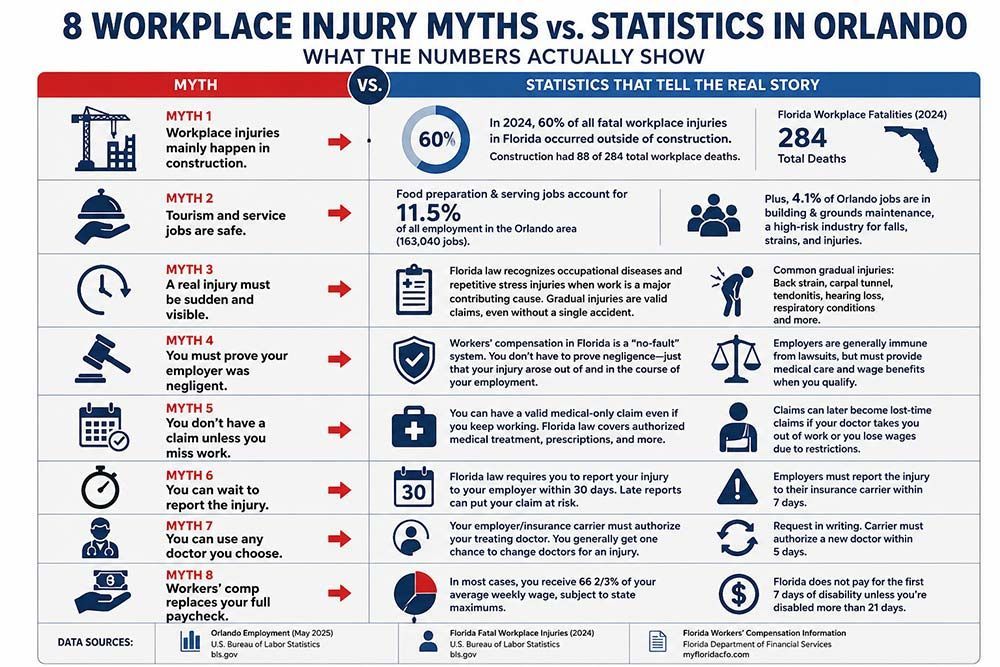
Construction is one of Florida’s most dangerous industries. It recorded 88 fatal work injuries in 2024, more than any other private industry sector in the state. Falls, slips, and trips caused 39 of those deaths.
However, workplace injuries are not limited to construction sites.
Orlando has large workforces in food service, sales, office support, health care, cleaning, maintenance, hospitality, transportation, and personal services. Food preparation and serving jobs alone accounted for 163,040 positions in the Orlando metropolitan area in May 2025.
A restaurant employee can suffer a burn or lifting injury. A hotel housekeeper can develop a back or shoulder condition. A retail employee can fall from a ladder or be struck by merchandise. A maintenance worker can be injured by machinery, electricity, or a fall.
Construction presents serious hazards, but it is only one part of the workplace injury picture in Orlando.
Myth 2: Tourism and Service Jobs Are Safe
Orlando’s hospitality and service industries employ thousands of people in physically demanding positions. Food preparation and serving occupations represented 11.5% of Orlando-area employment, compared with 8.8% nationally. Building and grounds cleaning and maintenance represented another 4.1%.
Workers in these jobs may spend long hours standing, lifting, bending, pushing carts, cleaning rooms, carrying supplies, handling hot equipment, or working around wet floors.
Service workers can experience:
- Back and shoulder injuries
- Slips and falls
- Burns and cuts
- Repetitive stress injuries
- Chemical exposure
- Workplace violence
- Heat-related illness
- Vehicle and equipment accidents
A job does not need to involve a crane or industrial machine to cause a serious injury. Repeated lifting, unsafe flooring, understaffing, rushed work, and poorly maintained equipment can cause lasting medical problems.
Myth 3: A Real Workplace Injury Must Be Sudden and Visible
Some work injuries result from a clear accident, such as a fall, collision, machinery incident, or falling object. Others develop gradually.
Florida workers’ compensation law recognizes occupational diseases under specific conditions. These claims may involve harmful workplace exposure or illnesses connected to conditions that are characteristic of a particular occupation. They usually require medical evidence establishing a connection between the employment and the condition.
Workers may also experience repetitive stress conditions involving the hands, wrists, shoulders, neck, or back. These problems can develop after months or years of repeated lifting, typing, gripping, reaching, or patient handling.
The absence of a dramatic accident does not automatically mean that a condition is unrelated to work. However, gradually developing conditions can be more difficult to prove. Medical records, job-duty descriptions, exposure evidence, and a clear history of symptoms may become especially important.
Myth 4: You Must Prove Your Employer Was Negligent
Florida workers’ compensation generally provides the main legal remedy against a covered employer for an injury arising out of employment. It is different from a standard personal injury lawsuit in which the injured person usually tries to prove negligence. Florida law generally makes workers’ compensation liability exclusive, subject to limited exceptions.
An employee does not ordinarily need to prove that a supervisor intended to cause the accident or that the employer was careless.
The worker must still establish that the injury is compensable under Florida law. Disputes may arise over whether the accident occurred at work, whether employment was the major contributing cause, whether the worker was performing job duties, or whether the requested treatment is related to the injury.
Workers’ compensation is often described as a no-fault system, but that does not mean every claim is automatically accepted.
Myth 5: You Do Not Have a Claim Unless You Miss Work
A worker may have a valid medical-only claim even when no disability checks are being paid.
Florida workers’ compensation may cover authorized medical treatment connected to the injury. The Florida Division of Workers’ Compensation states that an authorized medical provider provides necessary care, treatment, and prescriptions. Authorized medical bills should generally be submitted to the employer’s insurance company.
A worker may continue working while receiving:
- Doctor visits
- Diagnostic testing
- Physical therapy
- Medication
- Specialist care
- Work restrictions
A claim may later become a lost-time claim if the authorized doctor removes the employee from work or assigns restrictions that cause a qualifying loss of earnings.
Continuing to work does not necessarily mean the injury is minor. Many Orlando employees keep working because they need the income, even while experiencing significant pain.
Myth 6: You Can Wait to Report the Injury
Florida workers should report workplace injuries as soon as possible. State law generally requires an employee to notify the employer within 30 days after the accident or the initial appearance of the injury. Missing that deadline can place the claim at risk, although limited exceptions may apply.
Waiting can also create factual problems. The insurance carrier may question why the worker continued working, why no supervisor was told, or whether the injury occurred somewhere else.
An injury report should include:
| Information to Document | Examples |
|---|---|
| Date and Time | When the accident or symptoms occurred |
| Location | Hotel room, restaurant kitchen, warehouse, vehicle, job site |
| Cause | Fall, lifting, machinery, collision, exposure |
| Body Parts Affected | Back, shoulder, knee, head, wrist |
| Witnesses | Coworkers, supervisors, customers |
| Early Symptoms | Pain, swelling, weakness, dizziness, numbness |
Even when symptoms appear manageable, reporting the incident creates a record that may become important if the condition gets worse.
Myth 7: You Can Use Any Doctor You Choose
The employer or workers’ compensation insurance carrier generally authorizes the treating medical provider. Except for emergencies and certain other situations, a provider normally needs authorization before treating the worker if workers’ compensation is expected to pay.
However, the carrier does not have unlimited control.
Florida law generally gives an injured employee one opportunity to request a change of physician for an accident. The request should be made in writing. The carrier must generally authorize an alternative physician within five days after receiving the request.
Workers should be cautious about seeking treatment independently without first understanding the authorization rules. The insurance company may refuse to pay an unauthorized provider, even when the worker believes the treatment was necessary.
Myth 8: Workers’ Compensation Replaces Your Full Paycheck
Florida workers’ compensation usually replaces only part of an injured employee’s wages.
In most qualifying cases, benefit checks equal 66 2/3% of the worker’s average weekly wage, subject to the applicable legal maximum. The average weekly wage is generally calculated using earnings from the 13 weeks before the injury, excluding the accident week.
Simple Wage Example
| Calculation | Amount |
|---|---|
| Pre-Injury Average Weekly Wage | $900 |
| Approximate Rate at 66 2/3% | $600 |
| Approximate Weekly Difference | $300 |
Florida also generally does not pay disability benefits for the first seven days of disability. If the disability lasts more than 21 days, the insurance carrier may owe benefits for that initial seven-day period.
Workers should also understand the difference between retaliation and job protection. Florida law prohibits firing an employee because the employee filed or attempted to file a workers’ compensation claim. However, workers’ compensation law does not generally require the employer to keep the employee’s position open indefinitely.
What Injured Orlando Workers Should Do
After a workplace injury, an employee should report the accident promptly, request authorized medical care, and keep copies of all relevant records.
Useful documents may include:
- The accident report
- Medical records
- Work-status forms
- Pay stubs
- Photographs
- Witness information
- Messages with supervisors
- Insurance correspondence
- Mileage records for authorized appointments
Workers should review benefit checks carefully and ask questions when treatment, wage payments, or referrals are delayed. A claim that appears simple at first may become disputed when the condition worsens, the doctor recommends a specialist, or the employer cannot accommodate restrictions.
How Van Dingenen Law Protects Injured Workers in Orlando
At Van Dingenen Law, workers’ compensation is what we do. We help injured employees in Orlando and throughout Central Florida understand their rights, document their claims, and respond when an insurance company delays or denies benefits.
Our legal team assists with workplace injury claims involving falls, vehicle accidents, machinery, repetitive stress, occupational exposure, denied treatment, unpaid wage benefits, and permanent disabilities.
We can review the injury report, medical records, work restrictions, wage calculations, and communications from the insurance carrier. We also help workers address denied claims, delayed appointments, disputes about authorized doctors, and benefit checks that may be too low.
Our firm offers free case evaluations, and we bring more than 60 years of combined experience handling Florida workers’ compensation claims.
If you were hurt at work, do not allow workplace injury myths in Orlando to prevent you from asking questions or protecting your claim. Contact Van Dingenen Law to discuss what happened and learn which workers’ compensation benefits may apply.
The statistics show that workplace injuries are not limited to construction workers or dramatic accidents. They affect Orlando employees in hotels, restaurants, stores, health care facilities, offices, warehouses, vehicles, and maintenance positions.
Understanding the facts can help injured workers recognize a valid claim, avoid harmful delays, and take the proper steps after an accident.