10 Things Florida Employees Often Get Wrong About Workers’ Compensation
Workers’ compensation should provide medical care and financial support after a job-related injury. Yet outdated advice from coworkers, supervisors, and insurers can cause late reports, unauthorized treatment, missing evidence, and lost benefits. Clearing up the most common workers' compensation myths in Florida can help employees make better decisions from the start.
To learn more about the most common workplace injuries and the risks employees face across the state, check out our recent study:
The Most Common Workplace Injuries in Florida: A Data Breakdown
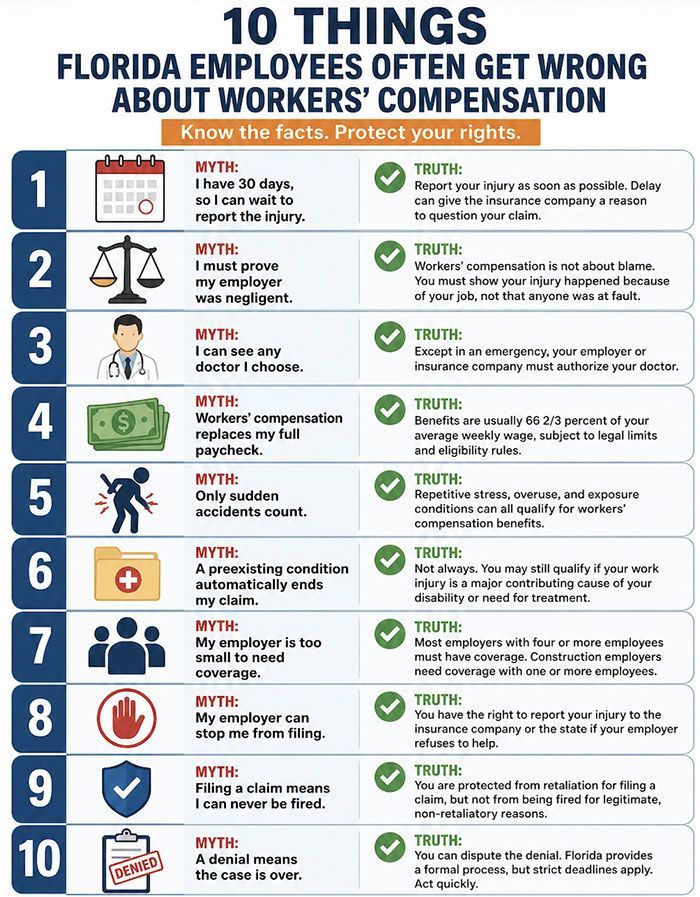
1. “I Have 30 Days, So I Can Wait to Report the Injury”
Florida law generally requires an employee to report a work-related injury within 30 days. That is a deadline, not a recommended waiting period. State guidance tells employees to report an accident as soon as possible. Delay may give the insurer room to question when the injury happened, whether it occurred at work, or whether another event caused it.
Report the injury promptly and preferably in writing. Explain when, where, and how it occurred, identify every affected body part, and keep a copy.
2. “I Must Prove My Employer Was Negligent”
One of the biggest workers' compensation myths in Florida is that an employee must prove the employer caused the accident through carelessness. Workers’ compensation is generally not a negligence lawsuit. A worker may qualify even when no one committed an obvious safety violation.
The employee must still establish that the injury arose out of and occurred in the course of employment. Florida also applies medical-causation standards, including the “major contributing cause” requirement in many cases. Certain misconduct, intoxication, or fraud may affect eligibility.
The central issue is usually the injury’s connection to the job, not whether the employer deserves blame.
3. “I Can See Any Doctor I Choose”
Except in an emergency, Florida claimants generally cannot select any physician and expect the insurer to pay. The employer or insurance carrier usually authorizes the treating doctor.
Using an unauthorized provider can create billing disputes and gaps in the evidence. After reporting an injury, ask where to obtain treatment. Tell every provider the condition is work-related, follow restrictions, and keep all paperwork. Changing doctors without following the required process can put benefits at risk.
4. “Workers’ Compensation Replaces My Full Paycheck”
Workers’ compensation wage benefits are not equal to ordinary wages. In many temporary total disability cases, the rate is 66 2/3 percent of the employee’s average weekly wage, subject to legal limits and eligibility rules. Other benefit categories use different formulas.
The average weekly wage calculation can be disputed. Missing overtime, tips, bonuses, concurrent employment, or incorrectly reported earnings may reduce checks. Employees should examine wage records rather than assume the insurer’s first calculation is correct.
5. “Only Sudden Accidents Count”
A fall from a ladder is easy to recognize as a workplace accident. Not every valid claim begins with one dramatic event. Florida law also addresses occupational diseases and repetitive-exposure injuries.
A claim may involve repetitive lifting, prolonged tool use, harmful substances, or another condition that developed over time. These cases often require detailed medical proof. Workers should report persistent symptoms and give doctors accurate information about their duties, exposure, and when symptoms began.
6. “A Preexisting Condition Automatically Ends My Claim”
An old injury, degenerative condition, or prior treatment does not automatically destroy a Florida workers’ compensation case. It can make causation more contested.
When a workplace injury combines with a preexisting condition, Florida’s major-contributing-cause rules may require proof that the work injury is more than 50 percent responsible for the disability or need for treatment compared with all other causes.
Employees should be honest about their medical history. Complete records may help distinguish old symptoms from a new injury or aggravation.
7. “My Employer Is Too Small to Need Coverage”
Coverage depends partly on industry and workforce size, but employees often guess incorrectly. Florida generally requires non-construction employers with four or more employees to carry coverage. Construction employers generally need coverage with one or more employees. Different standards apply to agriculture, government employers, contractors, and exempt business owners.
Part-time workers may count. A business also cannot always avoid responsibility simply by calling someone an independent contractor or using an uninsured subcontractor.
8. “My Employer Can Stop Me From Filing”
An employer may dispute a claim, but it does not have the final word. If the employer refuses to report the injury, the worker may contact the insurance carrier directly. The Florida Division of Workers’ Compensation also assists injured employees.
Document any refusal, threat, or instruction to use personal health insurance. Preserve the employer’s insurance information, which may appear on the mandatory workplace poster. A supervisor’s refusal does not necessarily close the case.
9. “Filing a Claim Means I Can Never Be Fired”
Florida law prohibits an employer from discharging, threatening, intimidating, or coercing an employee because the employee made or attempted to make a valid workers’ compensation claim.
That protection is not a permanent guarantee of employment. An employer may still act for legitimate, non-retaliatory reasons. Workers facing sudden discipline, reduced hours, threats, or suspicious termination should save emails, texts, schedules, reviews, and witness information.
10. “A Denial Means the Case Is Over”
Insurers deny claims for many reasons, including late notice, disputed causation, unauthorized care, or insufficient medical evidence. A denial is the carrier’s position, not necessarily the final result.
Florida provides a formal process for benefit disputes. An employee may seek help from the Employee Assistance and Ombudsman Office and may file a Petition for Benefits. Time limits apply; in general, a petition may be subject to a two-year deadline, although the correct deadline depends on the issue and claim history.
Waiting can weaken a disputed case as records become harder to obtain, memories fade, and deadlines continue to run.
Legal Support From Van Dingenen Law
Learning the truth about workers’ compensation myths in Florida is an important first step, but knowing your rights does not always make the claims process easy. You may still face delayed medical treatment, missing benefit checks, disputed work restrictions, questions about a preexisting condition, or an insurance company that refuses to accept your injury.
At Van Dingenen Law, we focus exclusively on representing injured workers throughout Florida. Since 2003, we have helped workers and their families during some of the most stressful moments of their lives. Our team brings more than 60 years of combined workers’ compensation experience and has recovered over $100 million for clients.
Workers’ Compensation Cases We Handle
We represent injured workers in cases involving:
- Workplace accidents and job-related injuries
- Occupational illnesses and exposure-related conditions
- Repetitive-stress and overuse injuries
- Delayed or denied medical treatment
- Denied workers’ compensation claims
- Missing or underpaid wage checks
- Workers’ compensation appeals
- Preexisting condition disputes
- Permanent disability and impairment benefits
- Workers’ compensation settlements
- Fatal workplace injuries and death-benefit claims
Industries and Sectors We Serve
We help injured employees across a wide range of Florida industries and employment sectors, including:
- Construction and skilled trades
- Healthcare and caregiving
- Hospitality, hotels, and restaurants
- Transportation, trucking, and delivery services
- Warehousing and distribution
- Manufacturing and industrial work
- Retail and customer service
- Office and administrative work
- Remote and telework positions
- Landscaping and agricultural work
- Maintenance, cleaning, and property services
- Public-sector and municipal employment
Every workplace injury is different. Whether you were hurt on a construction site, in a hospital, behind a desk, on the road, or while working from home, we can review the circumstances and explain the workers’ compensation benefits that may be available.
Contact our Florida workers’ compensation attorneys today to discuss your case, understand your rights, and learn how we may help you pursue the medical care and financial benefits you deserve.
Facts Protect Workers’ Compensation Claims
The most damaging workers' compensation myths in Florida often sound believable: wait to report the injury, use any doctor, trust the wage calculation, or accept the first denial. Each mistake can give an insurer another reason to delay or refuse benefits.
Prompt reporting, authorized medical care, accurate records, and immediate attention to disputes can protect an employee’s position. When an injury is serious, or the insurer resists the claim, legal advice can help the worker understand the available benefits, the applicable deadlines, and the next required steps.