How to File for Workers’ Comp as a Non-Citizen in Florida
A workplace injury can be frightening for any employee. Still, non-citizen workers often face an additional concern: Will filing a claim expose my immigration status or prevent me from receiving benefits?
Florida law does not make United States citizenship a basic requirement for workers’ compensation coverage. The state’s definition of an employee includes people who are lawfully or unlawfully employed and specifically includes aliens. In 2026, proposed legislation sought to restrict that protection, but the House and Senate bills died in committee. As of July 2026, immigration status alone does not automatically prevent an injured Florida employee from pursuing workers’ compensation.
Non-citizens must still follow the same reporting, medical, and claim requirements as other employees. They must also provide truthful information. A false Social Security number, identity document, or statement to an insurer can create a serious fraud defense.
Understanding how to file for workers’ comp as a non-citizen in Florida can help protect access to medical treatment, wage benefits, and the evidence needed to support a claim.
Who May Qualify as a Non-Citizen Worker?
Non-citizen workers may include lawful permanent residents, visa holders, refugees, asylum applicants, people with Temporary Protected Status, DACA recipients, and undocumented workers.
These categories are not legally identical, but Florida’s current workers’ compensation definition is broad. Immigration status does not replace the other requirements of a claim. The worker must still qualify as an employee, work for an employer required to carry coverage, and suffer a compensable job-related injury. Florida requires compensation for an accidental compensable injury arising out of work performed in the course and scope of employment.
Coverage rules depend on the employer’s industry and workforce. Construction employers generally need coverage with one or more employees, while non-construction employers generally need it for four or more. Agricultural employers have separate thresholds. Being paid in cash or labeled an independent contractor does not always settle whether someone is legally an employee.
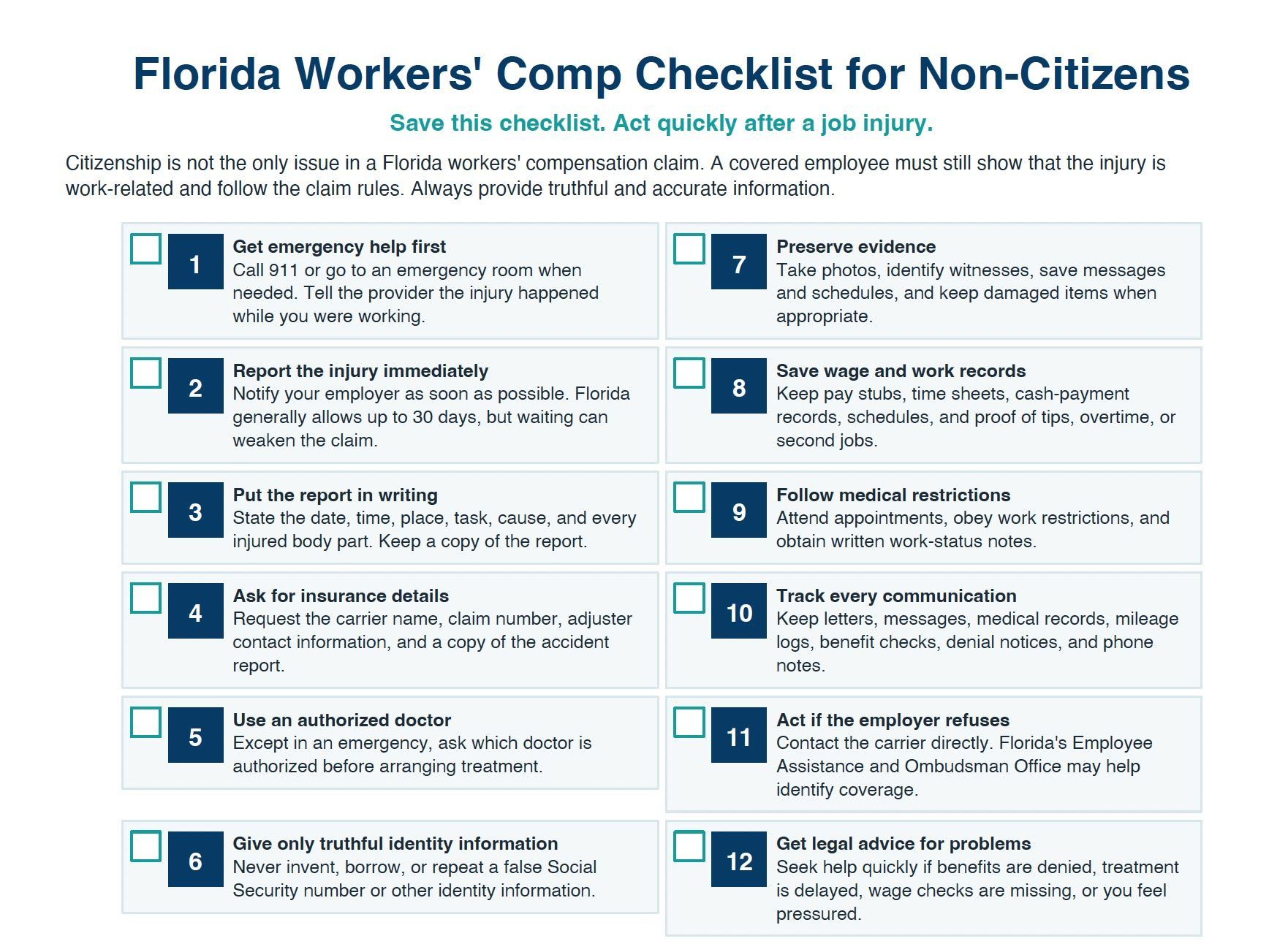
Step 1: Obtain Emergency Care
Call 911 or go to an emergency room when the injury requires immediate care. Tell the provider that the condition resulted from work and identify every injured body part.
For non-emergency treatment, ask the employer or insurance carrier where to go. Florida law requires employers to furnish medically necessary care for compensable injuries, but treatment is generally provided through authorized medical professionals. Covered care can include treatment, medication, medical supplies, equipment, and other services required for recovery.
Step 2: Report the Injury Immediately
Florida employees generally must notify their employer within 30 days after an accident or the initial manifestation of an injury. Waiting is risky. Delay may allow the insurer to question when the accident happened, whether it occurred at work, or whether another event caused the condition.
Report the injury to a supervisor, manager, owner, or human resources department as soon as possible. Put the report in writing and include:
- The date, time, and location
- The work task being performed
- What caused the injury
- Every affected body part
- Witness names
- A request for authorized treatment
Keep a copy of the email, text message, online form, or accident report.
Step 3: Ask the Employer to Open the Claim
In Florida, filing usually begins by reporting the injury to the employer rather than submitting a lawsuit or a one-employee application to the state.
After learning about the injury, the employer generally has seven days to report it to the insurance carrier and provide the worker with a copy. The carrier must send an informational brochure within three business days after receiving notice from the employer or employee.
Ask for the carrier’s name, claim number, adjuster’s contact information, and a copy of the First Report of Injury. These details make it easier to follow up directly and confirm that the employer reported the accident correctly.
Check the report carefully. Make sure the date, location, cause of injury, job title, contact information, and injured body parts are accurate. Request a correction if important information is missing or incorrect.
Step 4: Provide Only Truthful Identity Information
Never invent, borrow, buy, or repeat a false Social Security number or identity document when dealing with a doctor, pharmacy, employer, adjuster, or workers' compensation attorney.
Florida courts have confirmed that workers’ compensation may cover undocumented employees. Courts have also upheld the loss of benefits when a worker intentionally supplied false identity information for the purpose of obtaining workers’ compensation benefits.
Not every error automatically defeats a case because intent and the surrounding facts matter. Still, false, incomplete, or misleading statements can place the entire claim at risk.
A worker who lacks a Social Security number or does not understand an identity request should not guess. State the truth and obtain legal advice before signing or submitting information that may be inaccurate.
This rule applies to every part of the claim, including accident descriptions, prior injuries, medical history, work restrictions, wages, and current employment.
Step 5: Preserve Employment and Wage Evidence
Non-citizen employees are sometimes paid in cash or denied normal payroll records. Save any available proof of work and earnings, such as:
- Pay stubs and bank deposits
- Payment-app records
- Cash-payment logs or receipts
- Tax forms
- Work schedules and time sheets
- Uniforms, badges, or job-site passes
- Emails and messages from supervisors
- Photos of the workplace
- Proof of tips, overtime, bonuses, or a second job
Record the names and contact information of coworkers who can confirm duties, pay, working hours, or the accident.
This evidence may help establish employee status and calculate wage benefits if the employer’s records are incomplete. In many qualifying cases, wage-replacement benefits equal 66 2/3 percent of the worker’s average weekly wage, subject to Florida’s rules and limits.
Step 6: Follow the Authorized Medical Plan
Attend every authorized appointment and provide an accurate medical history. Explain your symptoms clearly without exaggerating or minimizing them.
Ask the doctor for a written work-status note after each visit stating whether you can return to work, must remain out of work, or can perform only restricted duties.
Follow lifting limits, therapy instructions, and prescription directions. Missed appointments or activities that conflict with medical restrictions may be used to challenge the claim.
Authorized workers’ compensation medical bills should generally be sent to the carrier rather than paid by the employee.
Step 7: Act if the Employer Refuses
An employer cannot erase an injury by refusing to complete paperwork. If the employer does not report the claim, the employee may contact the workers’ compensation insurance carrier directly.
Insurance information may be posted at the workplace. Florida’s Employee Assistance and Ombudsman Office can also help identify coverage and explain the state process. The office lists telephone assistance at 800-342-1741.
Document any instruction to remain silent, use personal health insurance, lie about where the injury happened, or avoid filing because of immigration concerns.
Florida law prohibits employers from discharging, threatening, intimidating, or coercing workers because they made or attempted to make a valid workers’ compensation claim.
Step 8: Challenge Denials and Delays Promptly
An insurer may dispute employee status, employer coverage, medical causation, wages, timely notice, or the accuracy of claim information. A denial is the carrier’s position, not always the final result.
A disputed worker may need to file a Petition for Benefits with Florida’s Office of the Judges of Compensation Claims. Deadlines apply and can depend on the benefit requested, prior treatment, and the history of the claim.
Do not ignore a denial letter, an unpaid medical bill, a missing wage check, or a treatment delay. Preserve the paperwork and seek advice quickly.
How Van Dingenen Law Helps Non-Citizen Workers
At Van Dingenen Law, we know that getting hurt at work can feel especially overwhelming when you are worried about your immigration status, your job, or how your family will manage financially. You may be unsure whom to trust or afraid that asking for benefits could create more problems. We are here to help you understand your rights and move forward with confidence.
Our firm focuses exclusively on Florida workers’ compensation. We help injured workers report claims, gather medical and wage records, obtain authorized treatment, pursue lost-wage benefits, challenge denied claims, and handle appeals when necessary.
We have represented injured workers and their families since 2003. We offer free case evaluations, and we handle workers’ compensation cases on a contingency-fee basis. This means you do not pay attorney’s fees unless we recover benefits for you.
Our help can be especially important if your employer refuses to report the accident, you were paid in cash, there are questions about your identity documents, or an insurance company is using immigration concerns to pressure or intimidate you. You do not have to face the process alone. We can listen to your story, explain your options, and fight for the medical care and benefits you may be entitled to receive.
Fast, Truthful Action Protects the Claim
The central lesson in how to file for workers’ comp as a non-citizen in Florida is straightforward: report the injury quickly, request authorized care, preserve evidence, and provide only accurate information.
Citizenship alone is not the deciding factor under Florida’s current law. A strong claim depends on a clear connection to work, prompt notice, consistent medical evidence, reliable wage records, and honesty throughout the process.
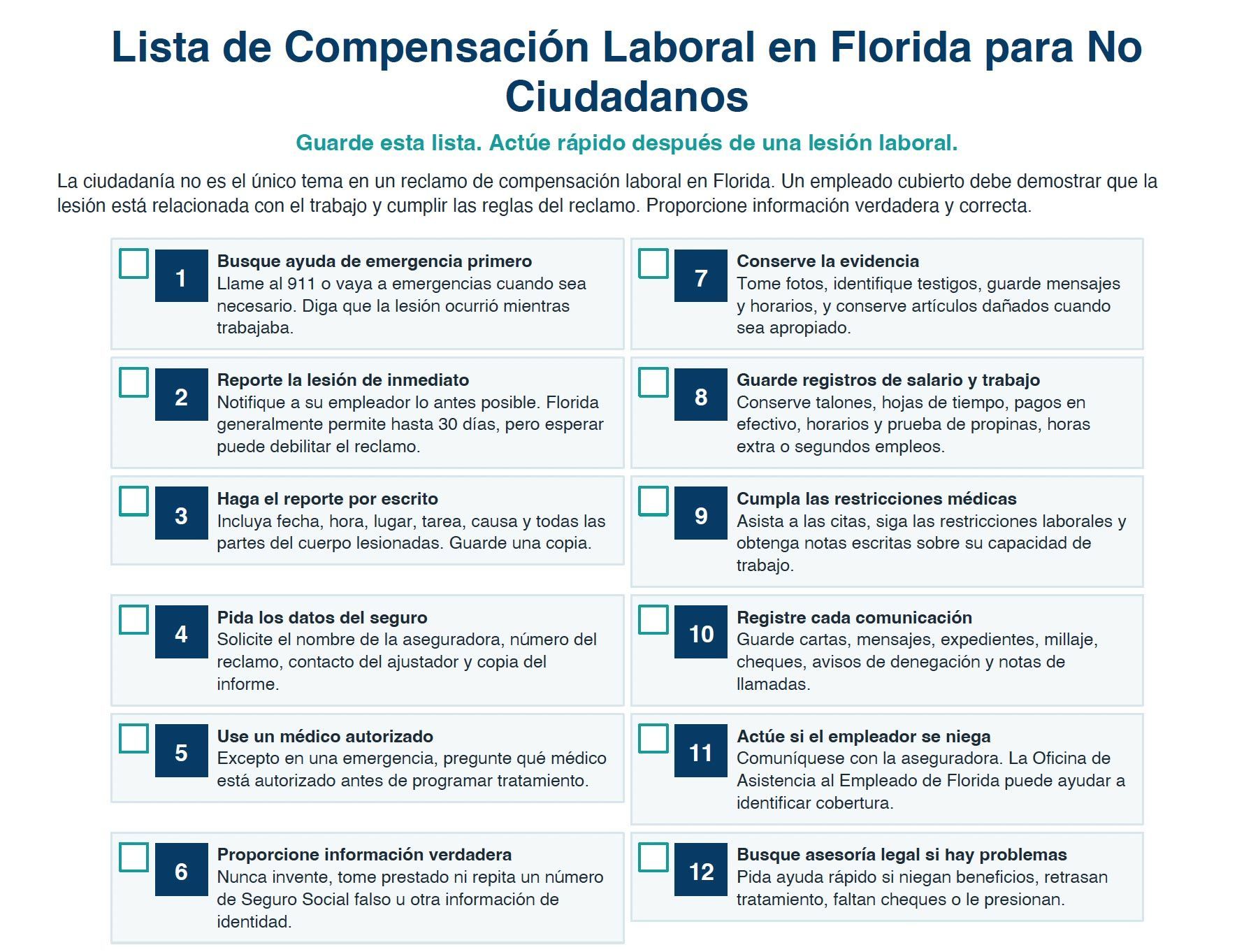
Downloadable Bilingual Checklist